Orangevale, CA · Lawn conversion
Replace Your Orangevale Lawn With a Low-Water Yard
Orangevale grew out of an 1890s orange-grove colony, and its big-lot, ranch-home streets still carry that character — along with a lot of wide, thirsty front lawns. In our zone 9b summers, where the heat sits over 100°F for weeks and the rain quits from May to October, keeping that grass green means running sprinklers hardest right when water costs the most. Replacing your front lawn with low-water plants cuts that summer irrigation, ends the weekly mow, and may qualify you for a local turf-replacement rebate. The catch in Orangevale is that several different agencies supply the town's water, so which rebate applies depends on who bills you. Use the free planner below to sketch your new yard, then take a real plan to your water provider and, if you want, a local installer. GoGarden is a planning tool — we don't sell or install anything.
Your water providerCentral Orangevale — the historic citrus-colony grid roughly bounded by Kenneth Avenue on the west, the point where Madison Avenue meets Greenback Lane on the east, Pershing Avenue on the south, and Oak Avenue on the north — is served by the Orange Vale Water Company (OVWC), a customer-owned mutual water company that has run since 1896 and serves about 5,500 connections. OVWC pumps none of its own supply; it buys 100% of its water wholesale from the San Juan Water District. Much of the west side and other non-core areas are served instead by the Citrus Heights Water District (CHWD), the south edge of town by the Fair Oaks Water District, and only a far-northeast sliver near the Placer County line by San Juan Water District's own retail division. Because San Juan is OVWC's wholesaler — not the retail utility that bills most of Orangevale — check the name printed on your water bill to confirm who actually serves your address.
Rebate options follow whoever bills you, so start with your water bill. Orange Vale Water Company customers should confirm any turf or landscape incentive directly with OVWC; Citrus Heights Water District customers should check CHWD's own turf/Cash-for-Grass program; and many Sacramento-region agencies coordinate through the Regional Water Authority's Be Water Smart effort at bewatersmart.info. San Juan Water District's Lawn Replacement Rebate applies only to actual San Juan retail customers — the far-northeast sliver of town — not to most of Orangevale, so don't assume it covers you just because OVWC buys its water wholesale from San Juan. Whichever program applies, you generally must apply and get written pre-approval, often after a pre-inspection, before you remove any grass; rebates are almost never retroactive, and funding, rates, and rules change often. We don't quote dollar amounts here on purpose — confirm the current terms with the provider on your bill before you plan around any rebate.
1 Pick a look
A knee-high tapestry of native grasses and sedges threaded with seasonal flowers — the relaxed, walkable look that reads as a meadow, not a cactus garden.
2 How much lawn are you replacing?
Not sure of your square footage? Size it by shape
Measure the lawn you're removing. For an odd shape, add a couple of rectangles together.
3 Your plant plan
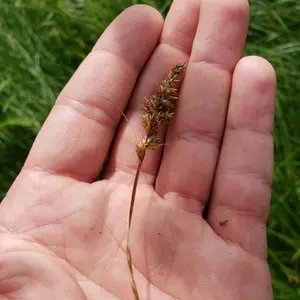
Clustered field sedge Carex praegracilis
2×1 ft · Sun–part shade · Evergreen
Premier no-mow lawn swap: mow short for turf or leave long for a meadow. Takes light foot traffic; wants regular water to stay green.
139 plants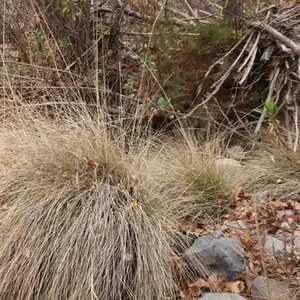
Deer grass Muhlenbergia rigens
4×3.5 ft · Full sun · Evergreen
Evergreen native clump with tall arching flower spikes for a strong accent. Keep it back from the house, out of the first 5 ft.
8 plants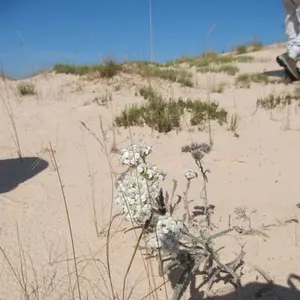
Common yarrow Achillea millefolium
2×1.5 ft · Full sun · Evergreen · Blooms late spring to summer
California native that knits into a soft, fern-leafy mat, staying low with white summer flower stalks. Tough and easygoing.
42 plants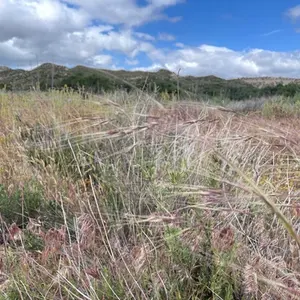
Purple needlegrass Stipa pulchra
2×3 ft · Sun–part shade
California's native state grass, great for erosion control and reseeds on its own. Keep it out of the first 5 ft by the house.
21 plants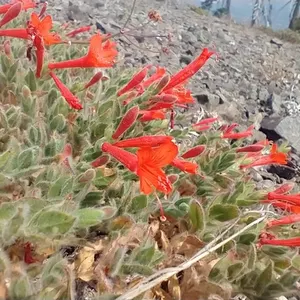
California fuchsia Epilobium canum
3.5×1.5 ft · Full sun · Blooms late summer to fall
Scarlet trumpet flowers late summer to fall make it a hummingbird favorite. Cut to the ground each winter for a fresh flush.
6 plants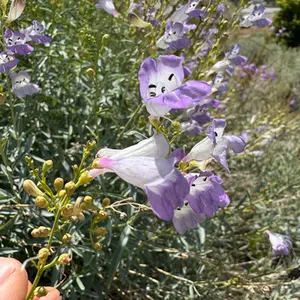
Foothill Penstemon 'Margarita BOP' Penstemon heterophyllus 'Margarita BOP'
2×1.5 ft · Full sun · Evergreen · Blooms spring to early summer
Electric blue-to-fuchsia tubular flowers pull in hummingbirds and native bees. The toughest, longest-lived foothill penstemon.
21 plants
Plant photos from iNaturalist contributors · CC BY / CC0. See the full plant guide →
🔥 Fire-smart placement: Deer grass, Purple needlegrass are drought-tolerant but more flammable — keep them out of the 0–5 ft strip against the house (Zone 0) and use the low-flammability plants there instead. Want a palette that's fire-safe right up to the wall? Try the look.
You're converting about 400 sq ft of lawn. Many Sacramento-area water providers pay a per-square-foot cash rebate for replacing lawn with low-water landscaping (often called Cash for Grass) — programs and rates change, so check your own provider's current offer and rules before you start.
Rebate programs usually want low-water plants covering a set share of the area and drip irrigation in place. This plan reaches roughly 100% live-plant coverage at maturity — GoGarden doesn't determine eligibility or amounts.
Want it installed?
Let a local pro know you're interested · no obligation
Plant counts use triangular on-center spacing and are planning estimates — buy a few extra for losses and confirm spacing with your nursery. Water use follows WUCOLS for the Central Valley; flammability guidance follows CAL FIRE / UC ANR; costs are 2026 retail assumptions, not quotes. Palette drawn for Sacramento (USDA zone 9b) — 48 plants and growing.
Who bills you for water in Orangevale — and where the rebate comes from
Orangevale is unincorporated Sacramento County, and its water map is unusually tangled, so the honest first step is to read the name on your bill. The historic core — the old citrus-colony grid roughly bounded by Kenneth Avenue on the west, the merge of Madison Avenue and Greenback Lane on the east, Pershing Avenue on the south, and Oak Avenue on the north — is served by the Orange Vale Water Company (OVWC), a customer-owned mutual company that has run since 1896 and serves about 5,500 connections. Here's the piece that trips people up: OVWC pumps none of its own supply. It buys 100% of its water wholesale from the San Juan Water District, treated from Folsom Lake at the Sidney N. Petersen plant. That makes San Juan OVWC's wholesaler — the agency behind the tap — not the retail utility that reads your meter. Much of the west side and other non-core areas are actually Citrus Heights Water District customers (CHWD serves portions of Citrus Heights, Fair Oaks, Orangevale, Carmichael, and Roseville, with more than 20,000 connections), the south edge of town falls under the Fair Oaks Water District, and only a far-northeast sliver near the Placer County line is served by San Juan's own retail division. Because each agency handles turf incentives differently, the provider printed on your bill — not your ZIP code — decides which rebate, if any, you can use.
Why convert your front lawn in Orangevale
Orangevale grew out of the 1890s "Orange Vale Colony," one of California's first successful agricultural colonies, laid out in ten-acre citrus and olive tracts. That heritage still shapes the town: generous lots, deep frontages, and streets of mid-century ranch homes, many of them fronted by a wide cool-season lawn that was cheap to plant and is now expensive to keep alive. In our USDA zone 9b climate, summers routinely sit above 100°F for weeks while the rain quits from roughly May to October, so holding that fescue or ryegrass green means running sprinklers hardest exactly when the Sacramento Valley has the least water to spare — and outdoor irrigation is usually the single biggest swing on a summer bill. Trading the front lawn for low-water plantings ends the weekly mow, cuts that peak-season use, and, along corridors like Central Avenue and Hazel Avenue, reads as a deliberate upgrade rather than a patchy, half-brown rectangle by August. A well-designed water-wise yard also rides out the drought-year watering-day limits that keep returning to the region far better than turf does, and it brings pollinators and songbirds back to a block that used to be all grass. Use the free planner below to map your real lawn footprint, test a few layouts, and get a realistic picture of the project before you talk to anyone or spend a dollar.
What grows well in an Orangevale yard
Orangevale is solid valley-floor zone 9b — hot, dry summers, mild wet winters — so the plants that thrive on little summer water once established are California natives and Mediterranean-climate species. For backbone structure, reach for manzanita, ceanothus (California lilac), toyon, and western redbud; for long, heat-proof color, Cleveland and autumn sage, California fuchsia, native buckwheat, yarrow, and penstemon; and for movement without a mower, deergrass and other native bunchgrasses. Lavender, rosemary, and westringia give evergreen mounds that shrug off the heat. Soil varies across town: parts of Orangevale sit on gravelly, fast-draining terrace and decomposed-granite ground that natives love, while other tracts sit over slower clay and hardpan — so on the heavier ground, plant on gentle mounds, roughen the sides of each hole rather than glazing the clay smooth, and space a little wider. The recipe is the same everywhere: group plants by how much water they want, put everything on drip, and top the soil with three to four inches of mulch to hold winter moisture and keep the ground from baking. Plant in the cool, wet season — fall through early spring — so roots establish before the first real heat. Regional turf-rebate programs generally require low-water, non-invasive plants plus efficient irrigation anyway, so a climate-matched palette keeps you eligible and keeps the yard full instead of sparse. The planner below lets you lay out beds and spacing and test these swaps against your own lawn.
Replacing a lawn in Orangevale — FAQs
Who is my water provider in Orangevale?
It depends on where in town you live. Central Orangevale — the historic citrus-colony grid around Central Avenue — is served by the Orange Vale Water Company, a customer-owned mutual water company. Much of the west side and other non-core areas are Citrus Heights Water District customers, the south edge of town falls under the Fair Oaks Water District, and only a far-northeast sliver near the Placer County line is served by San Juan Water District's retail division. Note that San Juan is Orange Vale Water Company's wholesaler — it sells OVWC its water — not the retail utility that bills most of Orangevale. Check the provider name printed on your water bill to be sure, because it determines which rebate program, if any, you can apply for.
My water comes from Orange Vale Water Company — can I use San Juan Water District's lawn rebate?
Generally no. San Juan Water District's Lawn Replacement Rebate is for San Juan's own retail customers — mostly Granite Bay and a small northeast sliver — not for Orange Vale Water Company customers. OVWC is a wholesale customer of San Juan: it buys 100% of its water from the district but bills and serves its own members as a separate mutual water company, so being an OVWC customer does not make you a San Juan retail customer. If OVWC bills you, confirm any turf or landscape incentive directly with Orange Vale Water Company, and check the Regional Water Authority's Be Water Smart resources at bewatersmart.info. We don't quote dollar amounts here because programs, rates, and funding change.
Do I have to get approval before removing my lawn?
Almost certainly, yes. Local turf and landscape rebates generally require you to apply and receive written pre-approval — often after a pre-inspection while the lawn is still in place — before you remove any grass. Tear out the turf first and you can disqualify yourself, because these rebates are almost never retroactive and funding is typically limited and first-come, first-served. Whether Citrus Heights Water District, Fair Oaks Water District, Orange Vale Water Company, or San Juan retail bills you, apply, wait for the written go-ahead, and document the before-and-after with photos and receipts before the first shovel goes in.
What should I plant instead of grass in Orangevale?
Lean into California natives and Mediterranean plants suited to zone 9b: manzanita, western redbud, ceanothus, and toyon for structure; salvias, California fuchsia, buckwheat, yarrow, and penstemon for low-water color; and native bunchgrasses like deergrass for movement, plus lavender and rosemary for evergreen mounds. Group plants by how much water they want, put everything on drip, and mulch three to four inches deep. Where your yard sits over clay and hardpan, plant on gentle mounds and space a bit wider; on the gravelly, fast-draining terrace soils common in Orangevale, drainage is already on your side. The planner helps you pick a palette that fits your yard's sun, size, and soil.
Does GoGarden install my new yard?
No — GoGarden is a free planning tool, not a landscaping contractor. We help you design the conversion, understand which local water provider and rebate program applies to your address, and, if you'd like, connect with independent local pros who can build it. We don't install anything, we don't pull your rebate paperwork, and using the planner costs nothing.
Areas we serve
Serving homeowners across Orange Vale Colony, Central Avenue, Sunrise Oaks, Hazel Avenue Corridor, Greenback Lane, Pershing Avenue, Almond Avenue and the greater Orangevale area.
Lawn conversion in nearby cities
aSaaSin Ventures LLC operates GoGarden — a free planning tool that can connect you with a local pro, not the installing contractor. Rebate programs, rates, and eligibility are set by your water provider and change often; confirm the current terms with them, and get any required written pre-approval, before removing turf. Plant and cost figures are planning estimates.