Spanish Springs, CA · Lawn conversion
Replace Your Spanish Springs Lawn With a Low-Water High-Desert Yard
Spanish Springs fills a closed high-desert valley northeast of Sparks at about 4,600 feet, ringed by the Pah Rah Range. What sets it apart from the Truckee Meadows floor is the cold: on clear nights, cold air drains off the surrounding hills and pools on the valley floor, so Spanish Springs sits in a reliably colder USDA zone 6b pocket — earlier fall frosts and later spring ones than Reno or Sparks. A cool-season lawn still drinks hard through the hot, dry summers, so replacing it with tough Great Basin plants cuts your biggest outdoor water use, ends the weekly mow, and lowers your bill. One heads-up worth having early: Northern Nevada has no Las Vegas-style turf rebate, so the payoff here is a smaller water bill, not a rebate check. Use the free planner below to sketch your new yard first, then take a real plan to a local pro if you want it built — GoGarden doesn't sell or install anything.
Your water providerSpanish Springs is split between two water utilities, so the name on your bill matters here more than in most Truckee Meadows towns. Most of the valley is served by Truckee Meadows Water Authority (TMWA), the regional public utility that also serves Reno and Sparks and is drilling new supply wells (Spring Creek Well 10) in north Spanish Springs to keep pace with growth. A separate portion of the valley is served by Great Basin Water Company, an investor-owned private utility (part of Nexus Water Group) regulated by the Nevada Public Utilities Commission. A handful of outlying or rural Washoe County homes draw from their own private domestic wells instead. Check the utility name printed on your water bill to confirm who actually serves your address — it decides whose watering rules and any programs apply to you.
Don't plan a Spanish Springs conversion around a turf rebate — Northern Nevada does not have the Southern-Nevada (Las Vegas / SNWA) style "cash for grass" turf buyback. Neither TMWA nor Great Basin Water Company pays you per square foot to remove a lawn. TMWA's conservation program centers on year-round assigned watering days, leak alerts, and smart-meter usage tracking rather than a lawn-removal payout; Great Basin Water Company, as a private regulated utility, focuses on efficient-use guidance rather than a rebate check. So the real savings from converting here come from a lower water bill and using far less water — not from a rebate. Programs can change, so ask whichever utility is named on your bill about any current incentive before you count on one, and never plan around a payout that may not exist.
1 Pick a look
A knee-high tapestry of native grasses and sedges threaded with seasonal flowers — the relaxed, walkable look that reads as a meadow, not a cactus garden.
2 How much lawn are you replacing?
Not sure of your square footage? Size it by shape
Measure the lawn you're removing. For an odd shape, add a couple of rectangles together.
3 Your plant plan
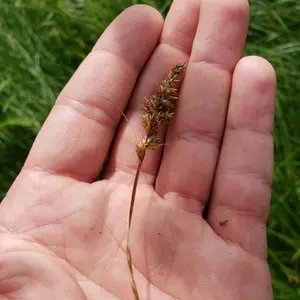
Clustered field sedge Carex praegracilis
2×1 ft · Sun–part shade · Evergreen
Premier no-mow lawn swap: mow short for turf or leave long for a meadow. Takes light foot traffic; wants regular water to stay green.
139 plants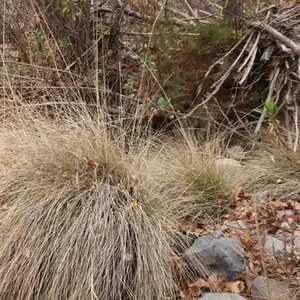
Deer grass Muhlenbergia rigens
4×3.5 ft · Full sun · Evergreen
Evergreen native clump with tall arching flower spikes for a strong accent. Keep it back from the house, out of the first 5 ft.
8 plants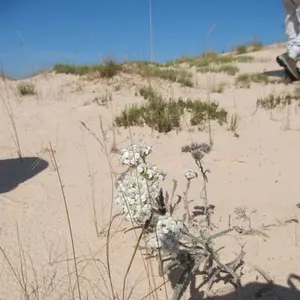
Common yarrow Achillea millefolium
2×1.5 ft · Full sun · Evergreen · Blooms late spring to summer
California native that knits into a soft, fern-leafy mat, staying low with white summer flower stalks. Tough and easygoing.
42 plants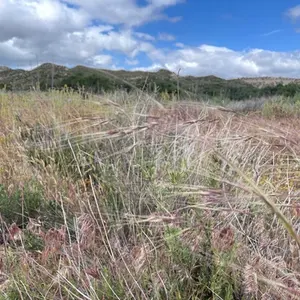
Purple needlegrass Stipa pulchra
2×3 ft · Sun–part shade
California's native state grass, great for erosion control and reseeds on its own. Keep it out of the first 5 ft by the house.
21 plants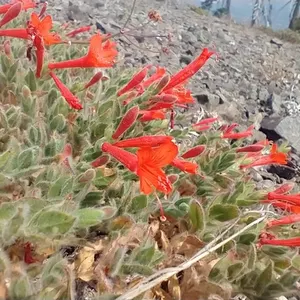
California fuchsia Epilobium canum
3.5×1.5 ft · Full sun · Blooms late summer to fall
Scarlet trumpet flowers late summer to fall make it a hummingbird favorite. Cut to the ground each winter for a fresh flush.
6 plants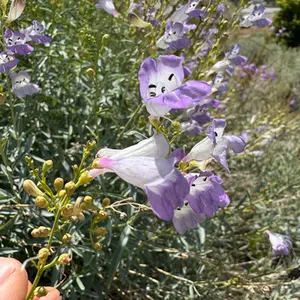
Foothill Penstemon 'Margarita BOP' Penstemon heterophyllus 'Margarita BOP'
2×1.5 ft · Full sun · Evergreen · Blooms spring to early summer
Electric blue-to-fuchsia tubular flowers pull in hummingbirds and native bees. The toughest, longest-lived foothill penstemon.
21 plants
Plant photos from iNaturalist contributors · CC BY / CC0. See the full plant guide →
🔥 Fire-smart placement: Deer grass, Purple needlegrass are drought-tolerant but more flammable — keep them out of the 0–5 ft strip against the house (Zone 0) and use the low-flammability plants there instead. Want a palette that's fire-safe right up to the wall? Try the look.
You're converting about 400 sq ft of lawn. Many Sacramento-area water providers pay a per-square-foot cash rebate for replacing lawn with low-water landscaping (often called Cash for Grass) — programs and rates change, so check your own provider's current offer and rules before you start.
Rebate programs usually want low-water plants covering a set share of the area and drip irrigation in place. This plan reaches roughly 100% live-plant coverage at maturity — GoGarden doesn't determine eligibility or amounts.
Want it installed?
Let a local pro know you're interested · no obligation
Plant counts use triangular on-center spacing and are planning estimates — buy a few extra for losses and confirm spacing with your nursery. Water use follows WUCOLS for the Central Valley; flammability guidance follows CAL FIRE / UC ANR; costs are 2026 retail assumptions, not quotes. Palette drawn for Sacramento (USDA zone 9b) — 48 plants and growing.
Who bills you for water in Spanish Springs — and the honest rebate picture
Spanish Springs is one of the few Truckee Meadows communities where you can't assume a single water utility, so start with the name on your bill. Most homes in the valley are served by Truckee Meadows Water Authority (TMWA), the regional public utility that also serves Reno and Sparks — it's even drilling new supply wells (Spring Creek Well 10) up in north Spanish Springs to keep pace with the valley's growth. But a distinct portion of the valley is served by Great Basin Water Company, an investor-owned private utility regulated by the Nevada Public Utilities Commission, and a handful of outlying parcels run on their own domestic wells. Here's the part that surprises newcomers from Las Vegas or California: Northern Nevada has no 'cash for grass' turf buyback. Neither TMWA nor Great Basin pays you per square foot to pull out a lawn. What TMWA does run is assigned-day watering — sprinklers on set days based on whether your street address ends in an odd or even number, with no watering on Mondays — while drip irrigation and hand watering are allowed any day. So a drip-fed, low-water yard both sidesteps that sprinkler calendar and drops your bill. That lower bill and the water you stop using are the real payoff, not a rebate. Confirm any current program directly with the utility named on your bill before you plan around it.
Why replace your lawn in the Spanish Springs valley
A cool-season lawn is a poor fit for the Spanish Springs valley, and the reason is more than just heat. This is a closed high-desert basin at about 4,600 feet, ringed by the Pah Rah Range, with intense UV, single-digit summer humidity, gusty afternoon wind, and only a few inches of rain a year — so a fescue or bluegrass lawn drinks hardest from May through September, exactly when the valley is driest. The valley's signature twist is cold-air drainage: on clear nights, cold air slides off the surrounding hills and settles on the valley floor, so Spanish Springs sits in a reliably colder USDA zone 6b pocket than the Reno or Sparks floors just to the south. That means a shorter, more frost-bracketed growing season stacked on top of the summer thirst — a lawn here is squeezed from both ends. Trading turf for low-water Great Basin plants, drip, and gravel or bark mulch cuts your single largest water use, ends the weekly mow, and gives you a yard that shrugs off wind, heat, and UV instead of browning out by mid-July. From the golf-course frontage in Wingfield Springs and around Red Hawk to the newer streets of Kiley Ranch, Pioneer Meadows, and Sky Ranch, a landscape designed for this cold-pocket high desert reads as a deliberate upgrade, not a neglected lawn.
High-desert plants for Spanish Springs — with an extra frost margin
Because Spanish Springs runs colder than the valley floors around it, lean toward the hardiest end of the Great Basin palette — and skip the Sacramento or Southern-California species you'll see online, which won't reliably survive a zone 6b cold snap. For structure, the toughest native shrubs carry the design: big sagebrush, rubber rabbitbrush, antelope bitterbrush, curlleaf mountain mahogany, fernbush, desert peach, Apache plume, three-leaf sumac, and Woods' rose, with adapted Russian sage for a softer look. For color that handles the UV and the big day-to-night swings, plant Rocky Mountain and firecracker penstemon, sulphur-flower buckwheat, blue flax, Munro's globemallow, showy four o'clock, angelita daisy, blanketflower, and yarrow. Native bunchgrasses — Indian ricegrass, Great Basin wildrye, blue grama, and Sandberg bluegrass — give the movement and soft, low-mow meadow feel people miss from a lawn, without the water or the mowing. Kinnikinnick, rosy pussytoes, and plains prickly pear fill in as groundcover and accent. Group everything by water need, run it all on drip, and top the beds with a few inches of gravel or bark mulch to hold what little moisture there is and buffer the soil against the cold. Timing matters even more here than in warmer pockets: plant in spring once the later local frost risk has passed, or in early fall so roots settle before the first hard freeze, and avoid tender, frost-sensitive plants entirely. The planner below helps you lay out beds and match a palette to your yard's sun, size, and soil.
Replacing a lawn in Spanish Springs — FAQs
Who provides my water in Spanish Springs?
It depends on your address — Spanish Springs is split between two utilities. Most of the valley is served by Truckee Meadows Water Authority (TMWA), the regional public utility that also serves Reno and Sparks. A separate portion is served by Great Basin Water Company, an investor-owned private utility (part of Nexus Water Group) regulated by the Nevada Public Utilities Commission. A few outlying homes are on private domestic wells instead. Check the utility name printed on your water bill to confirm who serves you — it determines whose watering rules and any programs apply.
Is there a rebate for replacing my lawn in Spanish Springs?
No. Northern Nevada does not have the Southern-Nevada, Las-Vegas-style 'cash for grass' turf buyback, and neither TMWA nor Great Basin Water Company pays you per square foot to remove a lawn. The savings from converting here come from a lower water bill and using far less water — not a rebate check. TMWA's conservation program leans on assigned watering days, leak alerts, and smart meters rather than a turf payout. If you want to know about any current incentive, ask the utility named on your bill directly — we don't quote amounts here because programs change and none may apply to you.
Why is Spanish Springs colder than Reno or Sparks?
Because it's a closed valley basin that traps cold air. On clear nights, cold air drains off the surrounding hills of the Pah Rah Range and pools on the valley floor, a pattern called cold-air drainage. That makes Spanish Springs a reliably colder USDA zone 6b pocket than the Reno or Sparks valley floors just to the south, with later spring frosts and earlier fall ones. Plan for a shorter growing season: choose cold-hardy Great Basin natives, plant in spring after frost risk eases or in early fall, and skip tender, frost-sensitive species.
What should I plant instead of grass in Spanish Springs?
Stick to the hardiest Great Basin natives suited to a colder zone 6b pocket: big sagebrush, rubber rabbitbrush, antelope bitterbrush, curlleaf mountain mahogany, fernbush, desert peach, and Apache plume for structure; Rocky Mountain and firecracker penstemon, sulphur-flower buckwheat, blue flax, globemallow, and blanketflower for color; and native bunchgrasses like Indian ricegrass, blue grama, and Great Basin wildrye for a low-mow, meadow feel. Group plants by water need, run everything on drip, mulch with gravel or bark, and avoid the Sacramento or Southern-California palettes — they aren't reliably cold-hardy here.
Does GoGarden install my new yard?
No — GoGarden is a free planning tool, not a landscaping contractor. We help you design the conversion, understand how Spanish Springs' two water providers and the honest no-rebate picture actually work, and, if you'd like, connect you with local pros who can handle the installation. We don't sell materials, pull any paperwork, or install anything ourselves, and using the planner costs nothing.
Areas we serve
Serving homeowners across Wingfield Springs, Kiley Ranch, Sky Ranch, Pioneer Meadows, Eagle Canyon, Stonebrook, Red Hawk and the greater Spanish Springs area.
Lawn conversion in nearby cities
aSaaSin Ventures LLC operates GoGarden — a free planning tool that can connect you with a local pro, not the installing contractor. Rebate programs, rates, and eligibility are set by your water provider and change often; confirm the current terms with them, and get any required written pre-approval, before removing turf. Plant and cost figures are planning estimates.